

A hosting decision matrix helps digital marketing agencies make clearer, more confident hosting choices by turning subjective comparisons into a structured scoring process. When you evaluate performance, security, scalability, support, and cost through weighted criteria, the right solution becomes obvious. This framework removes guesswork, aligns teams, and creates decisions you can defend during client reviews or planning cycles. With a hosting decision matrix, you choose environments that actually support campaign performance and long-term client growth.
Digital marketing agencies face unique hosting challenges. You manage multiple client sites with varying performance requirements, integrate complex marketing tools, and need hosting that scales with campaign demands. Each hosting decision affects client campaign performance, site speed, security, and your bottom line.
A hosting decision matrix brings clarity to these decisions. Instead of relying on vendor claims or gut instinct, it provides a structured framework to evaluate options based on what matters most: performance, scalability, support, and technical fit.
For agencies managing client portfolios, consistency matters. Variable page speeds hurt campaign performance. Different security standards create compliance gaps. Incompatible platforms limit your ability to deploy standardized analytics and optimization tools across client sites.
According to HubSpot’s 2024 Marketing Strategy & Trends Report, 82% of marketers say website performance directly impacts their ability to achieve campaign goals, yet 64% report inconsistent hosting performance across client portfolios.
This guide shows you how to build and use a hosting decision matrix tailored to digital marketing agency needs.
Why You Need a Hosting Decision Matrix
Meeting Compliance and Oversight Requirements
Agencies operate under strict frameworks like FISMA, FedRAMP, and EO 14028. You must demonstrate how security controls, data protection, and risk decisions align with these expectations. Both internal and external oversight organizations expect decisions to be traceable and defensible. Without clear documentation, even sound decisions can appear arbitrary during reviews.
A hosting decision matrix provides this structure. Rather than relying on informal conversations or undocumented assumptions, it lays out the criteria shaping final decisions. When an auditor asks why you selected one cloud provider over another, or why certain systems remained on-premises, you can point to specific weighted factors and scoring rationale.
This clarity proves especially valuable during audits, budget reviews, or modernization initiatives when leadership asks why one option was selected over another. The matrix transforms subjective discussions into objective analysis, making it easier to defend decisions and demonstrate due diligence.
Balancing Modernization and Risk
You face constant pressure to modernize while reducing long-term cyber risk. Some systems need modern cloud services to take advantage of rapid scaling, geographic distribution, or advanced services. Others require low-latency access, specialized hardware, or isolated environments best served by on-premises infrastructure. Still others handle data so sensitive that hybrid approaches offer the best balance.
The challenge isn’t choosing one model over another, it’s ensuring each system is placed in an environment matching its risk and mission profile. A blanket “cloud-first” or “on-premises only” policy rarely serves the full spectrum of agency needs. Different systems have different requirements, risk profiles, and operational characteristics.
A decision matrix enables structured comparison of hosting environments, allowing you to weigh performance, data sensitivity, compliance expectations, and operational needs without letting any single factor dominate. This balanced approach leads to better outcomes than policies driven primarily by cost savings or technology trends.
Reducing Cross-Program Inconsistency
Without a clear system, different teams often choose different hosting for the wrong reasons. One team picks cloud hosting because it seems flexible. Another team picks on-premises hosting because they want more control. But neither team can explain why their choice actually fits their needs better. This creates real problems: you waste money on duplicate systems, security doesn’t match across sites, teams can’t share resources, and systems don’t work together properly.
A hosting decision matrix fixes this by giving everyone the same way to evaluate options. Teams still might choose different hosting based on their specific needs, but they’ll use the same criteria to make those choices. For digital marketing agencies, this consistency matters even more. When client sites run on different hosting platforms, page speeds vary (which hurts campaign results), security gaps appear, and you can’t use the same analytics and marketing tools across all clients. A matrix helps you make smarter, more consistent hosting decisions.
Core Evaluation Criteria
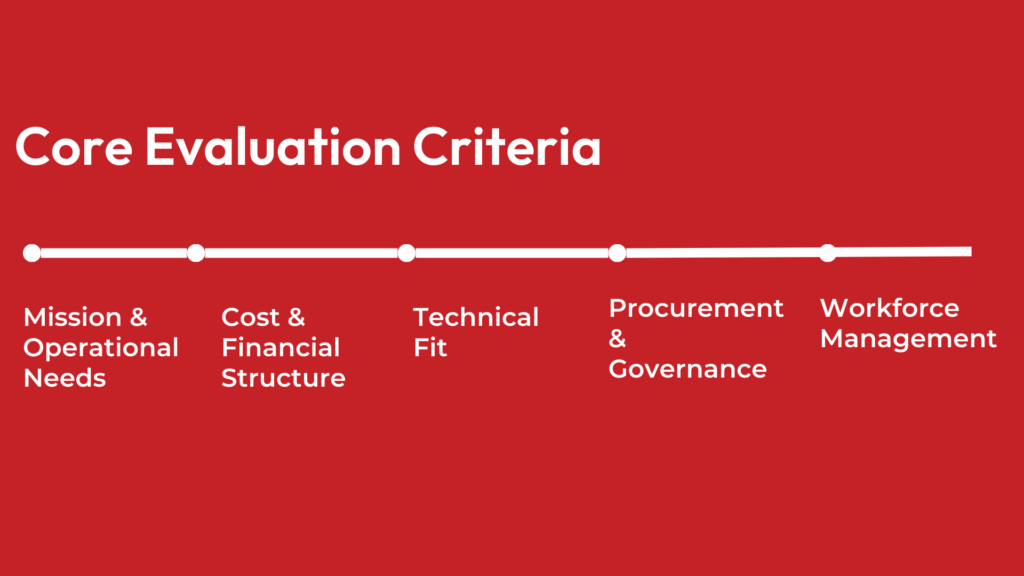
When evaluating hosting options, you need to consider six key areas. Each one affects whether a hosting solution will actually work for your agency.
Mission and Operational Needs
Start with the basics: What does your system need to do? An emergency response system that must stay online during disasters needs high-availability infrastructure than an internal scheduling tool.
Ask yourself: How critical is this system? Can it go down for maintenance, or must it stay online 24/7? Does it need to handle sudden traffic spikes, like 10x or 100x normal usage during emergencies? Research shows that a 1-second delay in page load time can reduce conversions by 7% and 53% of mobile users abandon sites that take longer than 3 seconds to load. Does it need to connect quickly to other systems or specialized equipment? These questions help you identify which hosting options can realistically support your mission.
A digital marketing agency managing 50+ client sites needs different infrastructure than one focusing on a handful of enterprise accounts. Campaign landing pages that must handle sudden traffic spikes from paid media require different considerations than steady-state corporate websites.
Cost and Financial Structure
The cheapest option upfront often costs more in the long run. You need to look at the total cost over several years, not just the initial price tag.
Cloud services often have low starting costs but can get expensive as you scale up. On-premises infrastructure costs more upfront but may be cheaper over five or ten years for systems that run constantly. Consider whether your agency prefers large one-time purchases (capex) or predictable monthly bills (opex). Both approaches work, they just fit different budget cycles.
Don’t forget migration costs. Moving a system to new infrastructure takes time, training, testing, and often running both old and new systems simultaneously. These transition costs can be substantial. A detailed cost analysis helps you defend your decisions during budget reviews.
Technical Fit
Not every system can run in every environment. Legacy applications might need specific software versions that cloud providers don’t support. Modern applications might need containers or specialized hardware that on-premises environments can’t provide economically.
Check if your application’s design matches the hosting environment. Some older applications were built to scale vertically (bigger servers) but cloud environments work better with horizontal scaling (more servers). If your system needs GPUs for processing, specialized security hardware, or must connect quickly to mainframes, determine which hosting options can provide what you need.
Putting a system in the wrong environment creates problems that cost time and money to fix later.
Procurement and Governance
Your procurement rules matter. Some agencies must use specific contracts or prefer certain vendor types (small businesses, veteran-owned companies, domestic operations). These requirements might eliminate otherwise good options.
Also consider: Can you switch providers later if needed? Vendor lock-in is a real concern. Check if you can easily export your data and move to another provider. Some hosting options make compliance reporting easier, while others require custom work to meet oversight requirements.
Sometimes a technically perfect solution that violates procurement rules causes more problems than a good-enough solution with clean governance.
Workforce and Management
Your team’s skills determine success. The best infrastructure is worthless if your staff can’t operate it effectively.
Cloud environments require different skills than on-premises infrastructure. Cloud staff need to understand cloud-specific security, cost management, and automation. On-premises staff need to manage hardware, perform maintenance, and handle physical security. What expertise does your team have now? What training would they need? How long would that training take?
If you lack expertise, you can hire managed service providers to fill gaps, but that adds cost and creates new dependencies. Also consider whether your team can provide 24/7 support if your mission requires it.
An advanced solution your team can’t manage provides less value than a simpler solution they can run confidently.
Practical Insights From the Field
Real Users Share Honest Experiences
Real users on forums like Reddit share honest experiences that official sales materials often skip. Engineers love how fast they can set up cloud hosting and how flexible it is. But they warn that costs can spike quickly if you’re not watching closely. Cloud billing surprises are one of the biggest complaints. They recommend setting up budget alerts right away and understanding exactly how pricing works before you commit.
On-Premises vs. Hybrid Approaches
System administrators often prefer on-premises hosting for different reasons. When you run high-traffic sites 24/7, owning your own servers can actually cost less than renting cloud space. You also know exactly where your data is stored and have complete control over your hardware. That said, many experts recommend hybrid setups because different sites have different needs. Cloud works great for test sites, seasonal campaigns, or backup systems. On-premises works better for high-speed databases or sites that need specialized hardware.
Common Problems to Watch For
Watch out for common problems that catch agencies off guard. Unexpected cloud bills when traffic increases, getting locked into one vendor’s system, slow speeds when moving data around, and hidden management work that sales teams don’t mention upfront. Include these real-world factors in your hosting matrix. Vendor brochures tell you what hosting can do, but user communities tell you what actually happens day-to-day, including problems that show up months later.
Communities like Server Fault consistently highlight these operational realities that emerge after the sales process.
Building and Using Your Matrix
Step 1: Identify Mission Requirements
Start by thoroughly documenting what the system must do. This foundation determines everything that follows.
Define your users. Who relies on this system, where are they located, and what are their expectations? A system serving field agents in remote locations has different requirements than one serving headquarters staff with high-bandwidth connections.
Establish performance demands. What response times are acceptable? What throughput is required? How much data storage is needed, and how fast must it grow?
Classify data sensitivity. What types of data does the system handle? What are the consequences of breach or loss? This classification drives security and compliance requirements.
Document availability requirements. Can the system tolerate downtime for maintenance? What happens if it’s unavailable during peak periods? How quickly must it recover from failures?
This requirements documentation sets the foundation for all subsequent scoring. Without clear requirements, scoring becomes subjective and inconsistent.
Step 2: Assign Weights to Each Criterion
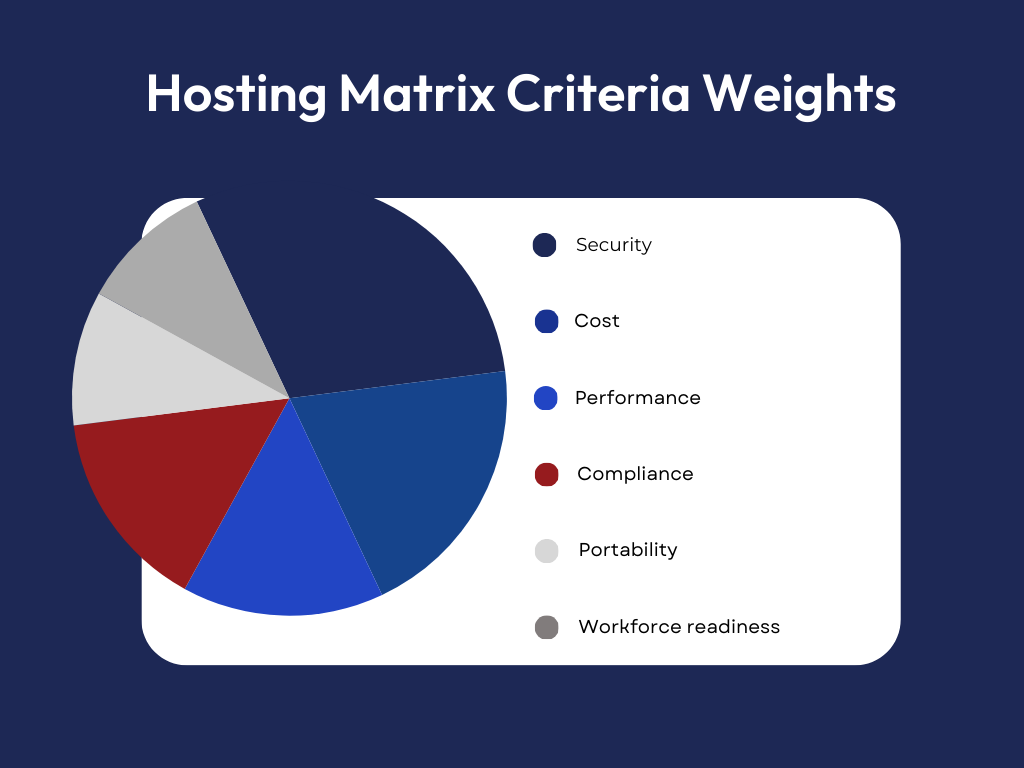
Weights reflect your organization’s priorities and the specific system’s characteristics. These weights should vary based on system criticality and mission profile.
A common example for a moderate-impact system:
Security: 30%
Cost: 20%
Performance: 15%
Compliance: 15%
Portability: 10%
Workforce readiness: 10%
For a high-impact, mission-critical system, you might adjust weights:
Security: 40%
Mission and operational needs: 25%
Compliance: 20%
Technical fit: 10%
Workforce readiness: 5%
For a low-impact, internal tool, weights might emphasize cost and ease of management:
Cost: 35%
Workforce readiness: 25%
Technical fit: 20%
Performance: 10%
Security: 10%
Adjust based on system importance and policy guidance. Document why you selected specific weights, this reasoning matters during reviews.
Step 3: Score Each Hosting Option
Using a standard scale (typically 1 through 5, where 1 is poor and 5 is excellent), rate each hosting type against each criterion.
For example, scoring security for a high-impact system:
On-premises (with modern infrastructure): 4 – Full control, but requires significant expertise
FedRAMP High cloud: 5 – Proven controls, continuous monitoring, vendor security expertise
Commercial cloud (non-FedRAMP): 2 – Insufficient controls for high-impact data
Hybrid: 4 – Combines control with cloud capabilities, complexity requires strong governance
Document reasoning behind each score to support auditing. Explain why one option scored higher than another. This documentation proves invaluable when defending decisions or revisiting them later.
Involve stakeholders from security, operations, finance, and mission teams in scoring. Different perspectives improve accuracy and build buy-in for eventual decisions.
Step 4: Generate a Recommendation
Multiply scores by weights to generate total scores for each option. For example:
On-Premises:
Security (40% × 4): 1.6
Mission needs (25% × 4): 1.0
Compliance (20% × 5): 1.0
Technical fit (10% × 5): 0.5
Workforce (5% × 3): 0.15
Total: 4.25
FedRAMP High Cloud:
Security (40% × 5): 2.0
Mission needs (25% × 3): 0.75
Compliance (20% × 5): 1.0
Technical fit (10% × 4): 0.4
Workforce (5% × 2): 0.1
Total: 4.25
The ranking provides a structured view of best-fit options. In this example, on-premises and FedRAMP High cloud score equally, suggesting either could work. Leadership then interprets results through the lens of mission realities, policy context, and workforce capacity to make the final decision.
Close scores indicate that multiple options could work, giving leadership flexibility. Wide score gaps indicate clear winners that should be selected unless overriding factors exist.
Criteria and Sample Scoring Matrix
Once you’ve defined your criteria and scoring scale, the next step is seeing how different hosting options compare in a real-world scenario. The example matrix below reflects the priorities of a typical digital marketing agency: last performance during campaigns, stable uptime, reliable support, secure environments, and compatibility with marketing tools. Your exact scores may differ, but this table shows how structured scoring helps you evaluate hosting choices more objectively.
How to Use This Hosting Decision Matrix
This matrix gives your team a structured way to compare hosting options instead of relying on instincts or vendor claims. Each criterion reflects something that directly affects digital marketing performance—site speed, campaign stability, security expectations, and ongoing operational needs.
Here’s how to work through it:
1. Confirm the weights match your priorities.
The default weights reflect what most marketing agencies care about: fast performance, stable uptime, secure environments, and predictable costs. If a client or project has different priorities (like strict compliance or extremely high traffic) you can adjust the weights before scoring.
2. Score each hosting option from 1–5.
Use simple numbers:
1 = Poor fit
3 = Acceptable but limited
5 = Strong fit
Score each hosting option honestly based on what it can deliver for your real workload—not what the vendor claims.
3. Multiply each score by the weight.
This shows how much each criterion contributes to the final decision.For example:Performance (25% weight) × Score of 5 = 1.25 contributing points
4. Add the weighted points to get a total.
The total score gives you an objective comparison across providers.It won’t make the decision for you, but it reveals which option is the best technical and operational fit.
5. Document why each score was chosen.
A short sentence for each score is enough. This helps during:
Team alignment
Client conversations
Budget reviews
Future audits
It also proves your choices weren’t arbitrary.
6. Use the results as your recommendation baseline.
If two options score close together, discuss trade-offs.If one option clearly leads, you have a defendable decision supported by a repeatable process.
Common Mistakes and Best Practices
Treating the Matrix as the Final Answer
The matrix supports decisions but cannot capture every nuance. Political relationships, strategic vendor partnerships, workforce morale, and organizational culture all influence outcomes. Leadership input remains essential for interpreting results and making final decisions.
Overweighting Cost at Security’s Expense
Short-term savings may lead to long-term risk, technical debt, or compliance setbacks. Security incidents can cost far more than the savings from choosing cheaper hosting. Balance cost against other factors appropriate to system criticality.
Using Outdated or Generic Criteria
Criteria must evolve with zero trust expectations, cloud policies, and technology shifts. A matrix developed five years ago likely doesn’t account for current security requirements or available capabilities. Review and update criteria regularly.
Applying One Matrix Across All Systems
Different risk tiers require different weightings. High-impact systems shouldn’t use the same matrix as low-impact internal tools. Develop templates for different system categories but customize for each significant decision.
Not Updating the Matrix Over Time
Revisit the matrix every 12–24 months to reflect changing priorities and technology conditions. New cloud capabilities, changed pricing, updated compliance requirements, or shifted mission priorities all affect scoring.
Ignoring Stakeholder Input
Decisions made in isolation face resistance during implementation. Involve security, operations, mission, and financial stakeholders in both weighting and scoring to build consensus and improve decision quality.
Best Practices
Tailor Criteria by System Sensitivity
High-impact systems deserve more weight on security, resilience, and performance. These systems cannot tolerate failures or security incidents. Lower-tier systems can prioritize cost and flexibility since consequences of problems are limited.
Document Assumptions for Audits
Clear documentation supports compliance and helps future teams understand past decisions. When someone asks in three years why you chose a particular option, documentation should provide clear answers. Record not just what you decided but why.
Use Standardized Scoring Rubrics
Develop clear definitions for each score level. What does a “3” mean for security? What distinguishes a “4” from a “5”? Standardized rubrics improve fairness and repeatability across programs. They also reduce subjective disagreements during scoring.
Revisit the Matrix Regularly
Technology, policies, and mission needs evolve. Your scoring framework should too. Schedule regular reviews to ensure criteria remain relevant and weights reflect current priorities.
Blend Quantitative Scoring With Expert Judgment
A strong matrix includes both measurable criteria and experienced judgment from security, architecture, and mission leadership. Numbers provide structure, but expertise provides context and wisdom. Use the matrix to inform decisions, not make them automatically.
Test the Matrix on Past Decisions
Validate your matrix by applying it to past hosting decisions. Does it produce results consistent with successful outcomes? If it recommends approaches that failed previously, adjust criteria or weights. This validation builds confidence in the framework.
Create Decision Templates
Develop matrix templates for common scenarios: high-impact databases, public-facing websites, internal tools, development environments. Templates accelerate future decisions while maintaining consistency.
Evaluating Performance-Focused Environments
Performance Features That Matter
Performance becomes more critical as your client sites grow and user expectations increase. Modern storage technology like NVMe drives load pages much faster than older hard drives, especially during traffic spikes from campaigns. Look for hosting that scales easily, either by upgrading to more powerful servers or by adding more servers that work together. Also check the uptime guarantee carefully: what percentage is promised, what happens if the site goes down, and what situations aren’t covered by the guarantee?
How Performance Affects Your Decision Matrix
These performance factors tie directly into your matrix scoring. They affect mission needs (can the hosting handle your traffic?), security and continuity (does the design prevent outages?), workforce readiness (is it easy for your team to manage?), and technical fit (does it work with your current tools and systems?). When evaluating options, focus on your actual requirements rather than brand names. Write down exactly what performance you need, then score each hosting option on how well it delivers those specific features.
Conclusion
A hosting decision matrix simplifies complex choices and keeps your agency focused on what matters. It improves clarity, speeds up alignment, and ensures every recommendation has a solid foundation. In practice, it helps you:
Compare hosting options based on the factors that truly affect performance and client outcomes
Document your reasoning so decisions are easy to defend and repeat
Apply a consistent process across teams while still adapting to unique client needs
vStart with one project, refine the approach, and roll it out broadly. For digital marketing agencies, this structure becomes a key part of delivering reliable results and maintaining client confidence.